Does a larger source resolution make the reference relatively larger?
For the reference background, no: when width and height grow by the same factor, its share of frame height stays the same. Its source-pixel dimensions grow, but that is not extra relative clearance. A changed aspect ratio or actual subtitle styling needs a fresh check.
Separate pixel size from relative size
We inspected the reference background formula in the checker. Its height is frame width times 0.042 times 1.65, or frame width times 0.0693. This expression describes the reference background, even when the typed line's font is later reduced to fit its width cap. It is not a measurement of real subtitles. Increasing source width increases that background height in source pixels.
Two equal-aspect inputs
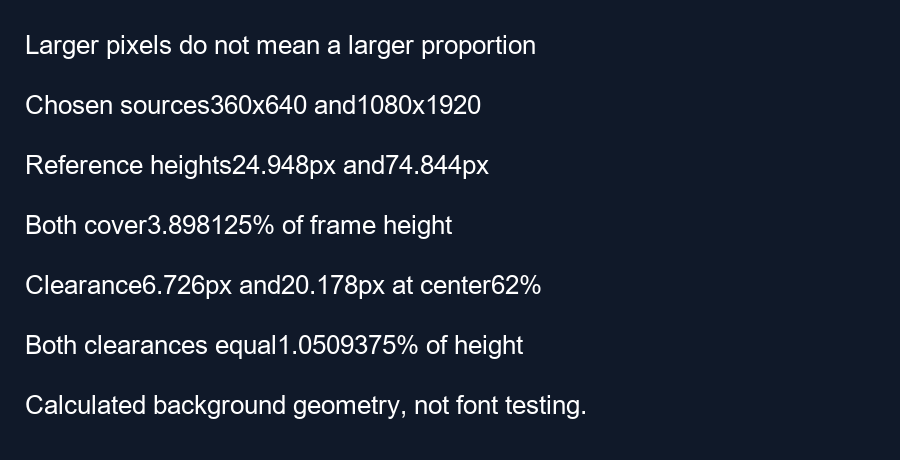
Choose frames of 360 by 640 and 1080 by 1920 pixels. The second width and height are each three times the first, so both frames have the same aspect ratio. The calculated reference background heights are 360 times 0.0693 equals 24.948 pixels and 1080 times 0.0693 equals 74.844 pixels. The second box is three times as tall in source coordinates.
Now divide each box height by its frame height. For the smaller input, 24.948 divided by 640 times 100 equals 3.898125 percent. For the larger input, 74.844 divided by 1920 times 100 also equals 3.898125 percent. Larger source coordinates alone have not increased the share of frame height occupied by this background.
Check the lower edge at an unchanged percentage
Choose the reference center at 62 percent and retain the default bottom guide at 65 percent of frame height. In the smaller frame, the center is 396.8 pixels and the guide boundary is 416 pixels. Adding half the background height gives a lower edge of 409.274 pixels and a clearance of 6.726 pixels.
In the larger frame, the center is 1190.4 pixels and the guide boundary is 1248 pixels. The lower edge is 1190.4 plus 37.422 equals 1227.822 pixels. Clearance is 20.178 pixels. Dividing each clearance by the relevant frame height gives the same 1.0509375 percent. Our independent script asserts these values rather than treating the larger pixel distance as extra relative protection.
Why the ratio cancels
For an equal scale factor S, the new width is S times W and the new height is S times H. Dividing the new box height, 0.0693 times S times W, by S times H cancels S. What remains is 0.0693 times W divided by H. A change of aspect ratio does not permit that cancellation, which is why square and portrait frames need a separate comparison.
This calculation covers background geometry and vertical clearance under chosen settings. It does not prove identical browser font rasterization, encoded video quality or physical display size. The preview may also be constrained by page layout. Review the final exported frame for the real subtitle treatment; source resolution is not a substitute for that inspection.
Questions and answers
Does a larger pixel clearance mean proportionally more room?
Not when the entire geometry scales by the same factor.
Does this establish identical text rendering?
No. The derivation concerns the reference background and coordinates.
What if the aspect ratio changes?
Recheck the composition. Width and height no longer share one scale factor.
Review your source · Compare different aspect ratios
Visual walkthrough
Text-led walkthrough without audio.