How precise is a caption position measured from a screenshot?
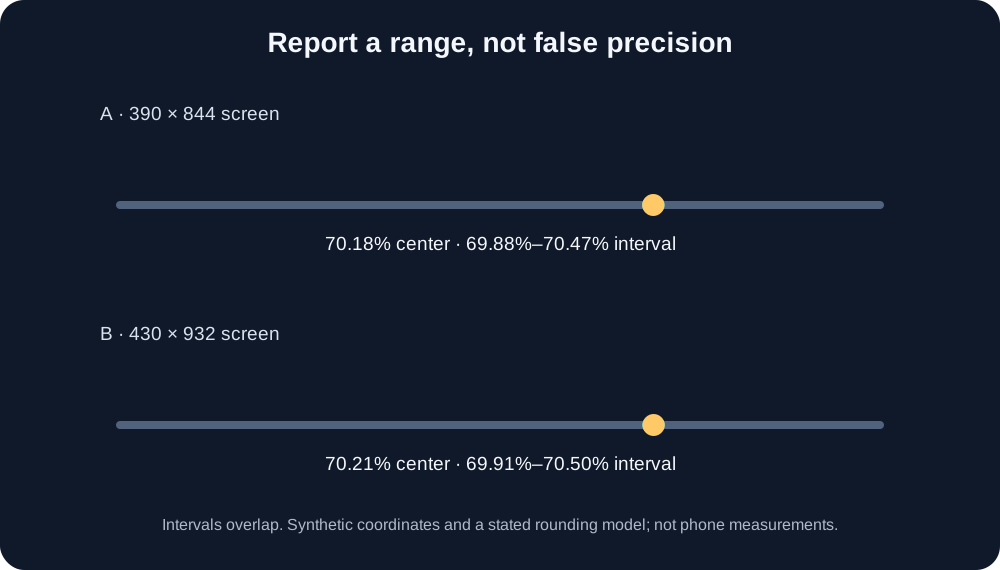
A screenshot-derived caption position should be reported with the measurement uncertainty. In this worked example, each measured horizontal coordinate is rounded to the nearest whole pixel, so the caption point and both video edges can each vary by ±0.5 px. The resulting normalized-position ranges overlap: the displayed center values differ by only 0.03 percentage points, which this measurement model cannot distinguish.
Propagate the pixel rounding
Let p be the caption anchor, l the video’s left edge and r its right edge. The center estimate is 100 × (p − l) ÷ (r − l). If all three coordinates were rounded to whole pixels, test the eight combinations where each gets either −0.5 or +0.5 px. For each combination calculate 100 × ((p + δp) − (l + δl)) ÷ ((r + δr) − (l + δl)); the smallest and largest results form the interval. This keeps the shared left edge in both numerator and denominator instead of treating their errors as independent.
Example A uses a 390 × 844 synthetic screenshot. Its displayed video spans x=24 to x=366, and the chosen caption point is x=264. The center estimate is 100 × (264 − 24) ÷ (366 − 24) = 70.18%. Enumerating the eight rounding combinations gives 69.88%–70.47%.
Example B uses a 430 × 932 synthetic screenshot with video edges x=36 and x=375 and caption point x=274. Its center estimate is 100 × (274 − 36) ÷ (375 − 36) = 70.21%; the eight-case interval is 69.41%–71.01%. The center estimates differ by 70.21 − 70.18 = 0.03 percentage points, but each center lies inside the other example’s rounding interval. Under the stated model, that tiny difference is not resolved.
Use the interval as a check, not a safety guarantee
This range covers only coordinate rounding under the stated assumption. It does not include screenshot scaling, resampling, ambiguous video borders, display zoom, player cropping, or changes to the app interface. If an image editor resizes the screenshot, a one-pixel uncertainty in the resized image may correspond to more than one source pixel. Record the original screenshot dimensions and any resize factor; do not compare ranges from different scaling workflows as if they share the same precision.
For vertical position, use the same eight-corner calculation with top edge, bottom edge and caption y coordinate. Keep the anchor definition constant—for example, the center of the caption box—and report the nominal value plus interval. A range crossing a chosen guide boundary means the measurement alone cannot decide which side the point is on; inspect the image or gather a higher-resolution capture. The guide boundary is a chosen reference, not proof of where every playback control appears.
The coordinates here are synthetic and chosen to demonstrate interval arithmetic. They are not device screenshots, YouTube interface measurements, or a universal safe-zone specification.
Questions and answers
Why do three coordinates have rounding error?
The relative location depends on the caption anchor and both video edges. If each is rounded to a whole pixel, each coordinate has its own half-pixel rounding interval.
Can I just add one pixel to the final percentage?
Not generally. The percentage is a ratio and the left edge appears in both the numerator and denominator. Recalculate the ratio for all eight endpoint combinations.
Does an overlapping interval mean the phones show the same interface?
No. It only means these synthetic coordinate estimates are not separated under the stated rounding model. It says nothing about interface similarity or real devices.
What if the screenshot was resized?
Record its original dimensions and scale factor. A pixel in a resized image may represent multiple source pixels, so the half-pixel assumption must be adjusted.
Open the local frame checker · Read the screenshot coordinate guide
Watch the short explanation
Synthetic coordinates show the arithmetic only; no visitor media or phone screenshots are used.
Context: YouTube’s Shorts upload guidance describes eligible square or vertical uploads, not a universal screenshot-measurement precision. A creator’s report of captions hidden by on-screen controls is anecdotal and motivates checking playback; it does not establish a platform-wide boundary. Existing guides from OrsonLord, CreateComfy and Kreatli describe overlays or checker workflows; this page adds an explicit coordinate-rounding interval calculation.