Does a bounding-box overlap prove visible caption pixels are covered?
No. A bounding box can include transparent gaps, so an overlap with a localized obstruction does not by itself prove overlap with visible caption pixels. A shared background can fill those gaps. Our saved binary-mask experiment demonstrates both cases; it is not a model of the actual YouTube interface.
Make the empty part of the box visible
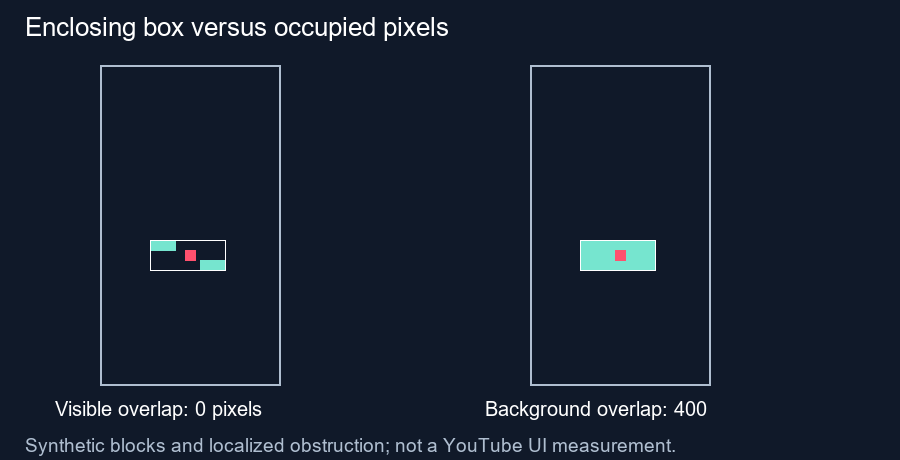
We built a binary caption mask inside a 360 by 640 frame. It contains two filled blocks: x coordinates 100 through 149 at y 350 through 369, and x 200 through 249 at y 390 through 409. Each block contains 50 times 20, or 1,000 pixels. Together they occupy 2,000 pixels. These blocks represent separated visible regions for an experiment; they are not rendered letters.
The smallest axis-aligned rectangle containing both blocks runs from x 100 to 249 and y 350 to 409, inclusive. That is 150 by 60, or 9,000 pixels. Much of the enclosing rectangle is empty. A bounding box records extreme coordinates, not the shape of every visible part inside it.
Place a synthetic overlay in the gap
Our chosen obstruction is a filled square spanning x 170 through 189 and y 370 through 389. Its area is 20 times 20, or 400 pixels. It lies inside the enclosing rectangle but between the two caption blocks. This square is a deliberately constructed obstruction, not a measured YouTube button or an official interface specification.
We saved separate masks for the caption, its enclosing rectangle and the obstruction. For each pair, our script counts coordinates where both masks are nonzero. The bounding-box intersection contains 400 pixels. The visible-caption intersection contains zero. Here the boxes intersect without the chosen visible caption regions being covered.
Add a background and repeat the same test
Next we fill the entire enclosing rectangle as a shared caption background, leaving all coordinates unchanged. That background is now visible at the square's location. Its intersection with the obstruction contains 400 pixels. The previous zero-overlap result no longer applies, because we changed the visible footprint.
As a positive control, we add a filled block exactly at the obstruction coordinates to the original two-block caption mask. The intersection count becomes 400 again. This confirms that the counting procedure distinguishes a genuinely occupied region from the empty space within the enclosing box.
Keep a conservative check and a coverage claim separate
Our experiment answers whether intersection of enclosing shapes proves intersection of occupied pixels for this nonrectangular caption and localized obstruction. It does not establish readability, acceptable spacing or whether an interface will move. Real antialiased text, semi-transparent shadows and blurred effects require a defined alpha threshold; our masks use only zero and fully filled pixels.
A simple guide rectangle remains useful for reserving space without modeling every interface element. This experiment does not tell you to place text inside excluded guide areas. In particular, an empty gap around one chosen square is not proof of clearance from the rest of an interface. The tool previews a guide and reference; it does not perform the pixel-mask collision test described here.
Inspect the final exported frame with the complete caption styling. If a background, shadow or animation fills an apparent gap, include it in the footprint. Treat a bounding-box warning as a reason to inspect placement, and avoid describing it as a measured count of covered letters.
Questions and answers
Can a caption box include transparent space?
Yes. A box encloses extreme coordinates and can contain gaps between visible parts.
Does this prove that guide overlap is harmless?
No. The experiment uses one chosen localized obstruction. It does not measure the rest of the interface.
Does this checker test visible-pixel collisions?
No. The saved masks and intersection counts belong to this separate experiment.
Review your exported frame · Include the caption background
Visual walkthrough
Text-led walkthrough without audio.